
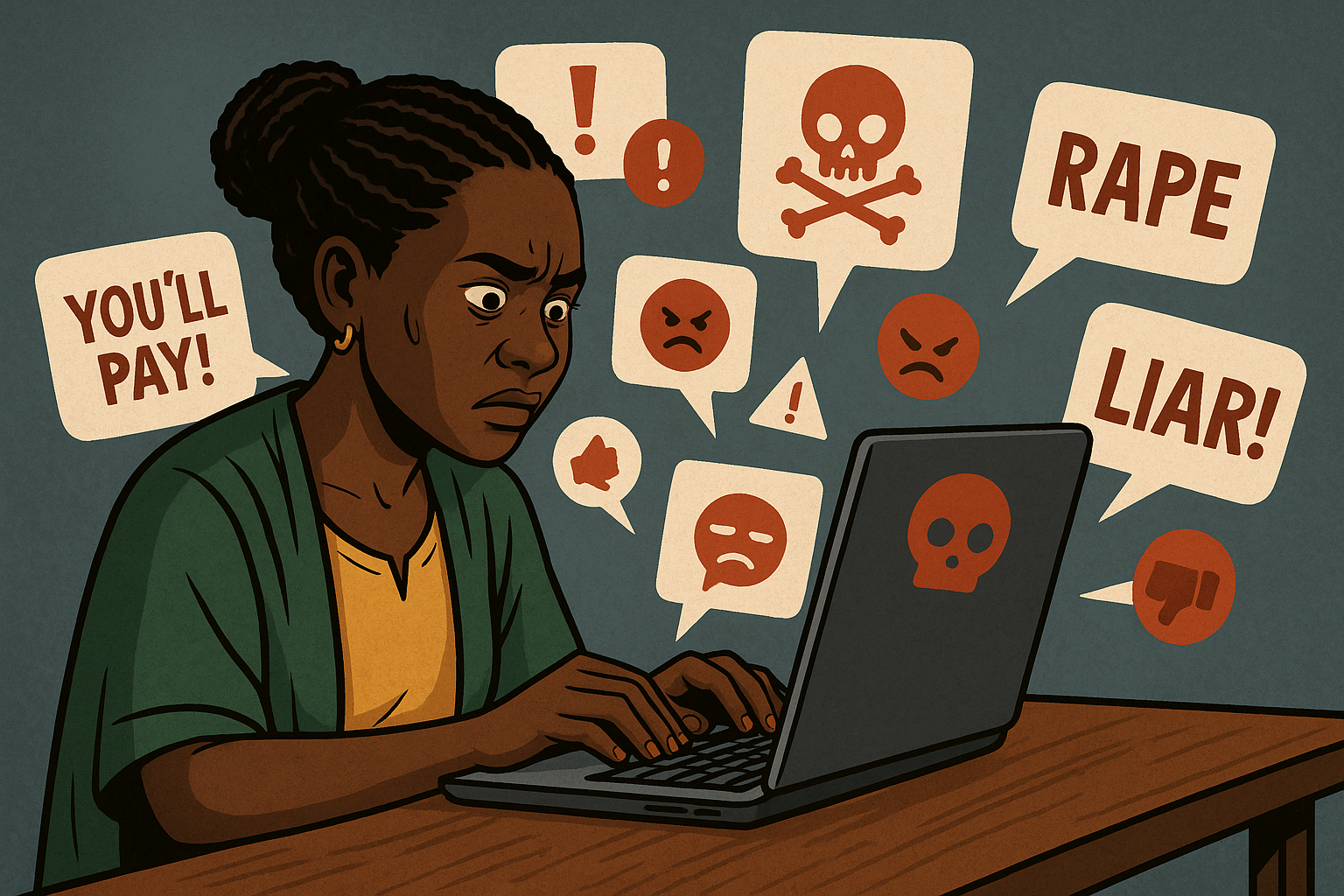
In Uganda and across the world, more and more women are paying a heavy price for speaking up online. Women human rights defenders, journalists, organizers, and community activists are being targeted not only on the streets and in meeting halls but also in inboxes, comment sections, and WhatsApp groups. From coordinated trolling and sexualized insults to doxxing, deepfakes, and death threats, digital spaces have become another frontline in the struggle for justice. These are not isolated “bad comments”; they are strategic tools used to intimidate, discredit, and push women out of public life.
This year’s 16 Days of Activism theme, “UNiTE to End Digital Violence Against All Women and Girls,” is a direct response to this crisis. Digital violence, often referred to as technology-facilitated gender-based violence (TFGBV), is not “just words on a screen.” It mirrors and amplifies the patriarchal power structures that drive offline violence and frequently spill over into physical attacks. Recent UN Women research finds that around seven in ten women human rights defenders, activists, and journalists globally have experienced online violence, and about four in ten have also faced offline attacks linked to that abuse.
For women activists in Uganda organizing around land justice, corruption, democracy, climate justice, or bodily autonomy, this violence is designed to silence them, isolate them, and make them pay for daring to speak. Global estimates suggest that 16% to 58% of women have experienced some form of online abuse, but less than 40% of countries have laws that specifically address cyber-harassment or online gender-based violence (UN Women, 2021; UN Women, 2022). This gap leaves many, especially activists, without meaningful protection or access to justice.
Understanding digital gender-based violence as a continuum of harm, not a separate or lesser form of abuse, is essential if we are to protect women activists and strengthen the movements they lead. This 16 Days, Solidarity Uganda joins the call to UNiTE to End Digital Violence Against All Women and Girls by shining a light on what women human rights defenders are facing online, and by supporting movements to respond with solidarity, protection, and collective power.
Why does standing against TFGBV matter for movements and democracy?
Digital violence against women activists is not just a personal attack; it is a deliberate strategy to weaken movements and shrink civic space. When a woman human rights defender is bombarded with threats, insults, and disinformation every time she speaks, the message is clear: “Stay silent or pay the price.” Over time, many reduce their online presence, avoid certain topics, or leave platforms altogether. This silencing hits hardest at youth- and women-led movements that rely on social media and messaging apps to organize, share information, and mobilize communities.
The result is a climate of fear and self-censorship. Women activists start to weigh every post: “Is it worth the backlash? Will this put my family at risk?” Issues like state violence, land grabs, corporate abuses, and sexuality become even harder to talk about because of the predictable waves of online harassment. When some voices are pushed out, the conversation becomes narrower and less reflective of the realities on the ground, especially for the most marginalized.
Digital violence also significantly impacts mental health. Constant attacks create stress, anxiety, and a sense of being watched or hunted, even in supposedly “safe” spaces like home. Many women defenders describe exhaustion, loss of confidence, and burnout after repeated online assaults. Movements then lose leaders and organizers not only to arrests, exile, or poverty, but also to trauma and fatigue. This invisible cost rarely makes headlines, but it quietly erodes organizing capacity over time.
Simultaneously, authorities often use online hate and smear campaigns to legitimize repression. When women activists are portrayed as “foreign agents,” “immoral,” “un-African,” or “violent,” it becomes easier for authorities or powerful interests to justify surveillance, raids, and restrictive laws in the name of “order” or “morality.” Driving women out of digital spaces doesn’t just harm individuals; it narrows public debate and undermines inclusive democracy by discouraging other women and girls from ever stepping into public life.
For a movement-building organization like Solidarity Uganda, this means digital violence is not a side issue or a “women’s problem.” It is a direct attack on communities’ power to organize, tell their own stories, and hold power to account. Protecting women activists online is, therefore, central to defending civic space and strengthening nonviolent resistance in Uganda.
What movements and allies can do.
Centre women activists’ experiences in our organizing. Women human rights defenders need room to speak openly about the abuse they face without fear of dismissal or minimization. Creating safe spaces, both online and offline, allows activists to share patterns of harassment, identify common perpetrators, and collectively analyze when attacks escalate. This knowledge strengthens movement strategies by helping organizers anticipate risks and prepare responses rooted in solidarity rather than isolation.
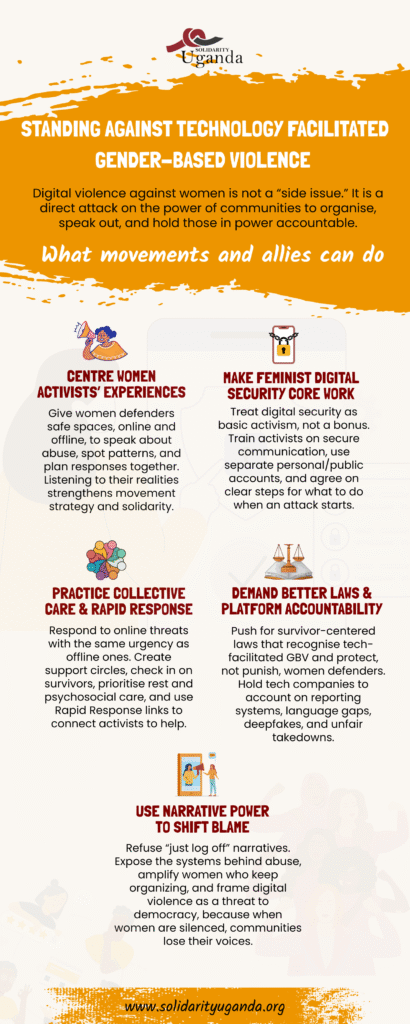
Integrate feminist digital security into movement work. Digital security is no longer a technical add-on; it is a core requirement for activism. Movements can build this capacity through regular trainings on secure communication. Women activists may also benefit from separating personal and public profiles, and from having clear protocols for what to do when an online attack begins, for example, who to inform, what to document, and how to escalate threats safely.
Practice collective care and rapid response for digital violence. Treating serious online threats with the same urgency as in-person or phone threats is crucial. Movements can establish support circles where experienced organizers guide younger activists through harassment episodes, helping them avoid isolation. Collective care also means recognizing the emotional burden of online abuse, checking in on affected activists, encouraging rest, and offering psychosocial support after intense waves of attacks. Protecting activists’ mental well-being is essential for the sustainability of movements. Through our Rapid Response department, we bridge the gap between activists and care providers, ensuring activists under threat get the necessary support.
Demand better laws and platform accountability. At the policy level, movements and allies must push for stronger, survivor-centered laws and genuine accountability from tech platforms. Many countries still lack legislation that recognizes technology-facilitated gender-based violence or provides meaningful pathways for justice. Advocacy should focus on closing these gaps, ensuring that laws protect women defenders rather than being weaponized against them. Social media companies must also be challenged to improve their reporting systems, especially in African languages, crack down on non-consensual intimate imagery and deepfakes, and offer fair appeals processes when activists’ accounts are wrongly taken down due to coordinated false reporting.
Use narrative power to shift blame from victims to systems. The dominant narrative often tells women to “log off,” “ignore it,” or change their behavior, placing responsibility on victims instead of addressing the patriarchal and political structures behind the abuse. By amplifying the stories of women who continue to organize despite attacks, movements can reclaim power from those who seek to silence them. Framing digital violence as a threat to democratic participation, not just a “women’s issue,” helps the public understand that when women activists are pushed out of digital spaces, whole communities lose vital voices and leadership.
Violence against women and girls is not inevitable. It is a political choice, upheld or dismantled by the actions of states, companies, communities, and movements. For women human rights defenders, community organizers, and activists in Uganda, the digital space is both a powerful organizing tool and a dangerous battleground. Ending digital violence is therefore not optional; it is central to protecting our movements, our democracy, and our collective power to imagine a different future.
This 16 Days, Solidarity Uganda stands with every woman whose phone screen has become a site of attack because she dared to defend her community. We commit to listening to their experiences, strengthening feminist digital security, and organizing for laws, platforms, and cultures that protect, not punish, women who speak out.
To UNiTE to End Digital Violence Against All Women and Girls is to insist that no activist should have to choose between her safety and her voice. Our movements are stronger when every woman can organize, online and offline, without fear.
About The Author
